
Scale matters in everything we do. For example, building a house is not the same as building a skyscraper. While some things are always true – buildings need a roof, doors and windows, other design principals are unique to a particular scale. A skyscraper may need elevators and a steel frame to support its size.
Thinking at scale is a fundamental design principle in the access-to-justice space. It is important because the needs of a user, and therefore our design goals, differ across each scale. Thinking this way also helps us place our other design principals in proper context.
As we discuss each scale, ask yourself: What is a user trying to accomplish?
Micro Scale
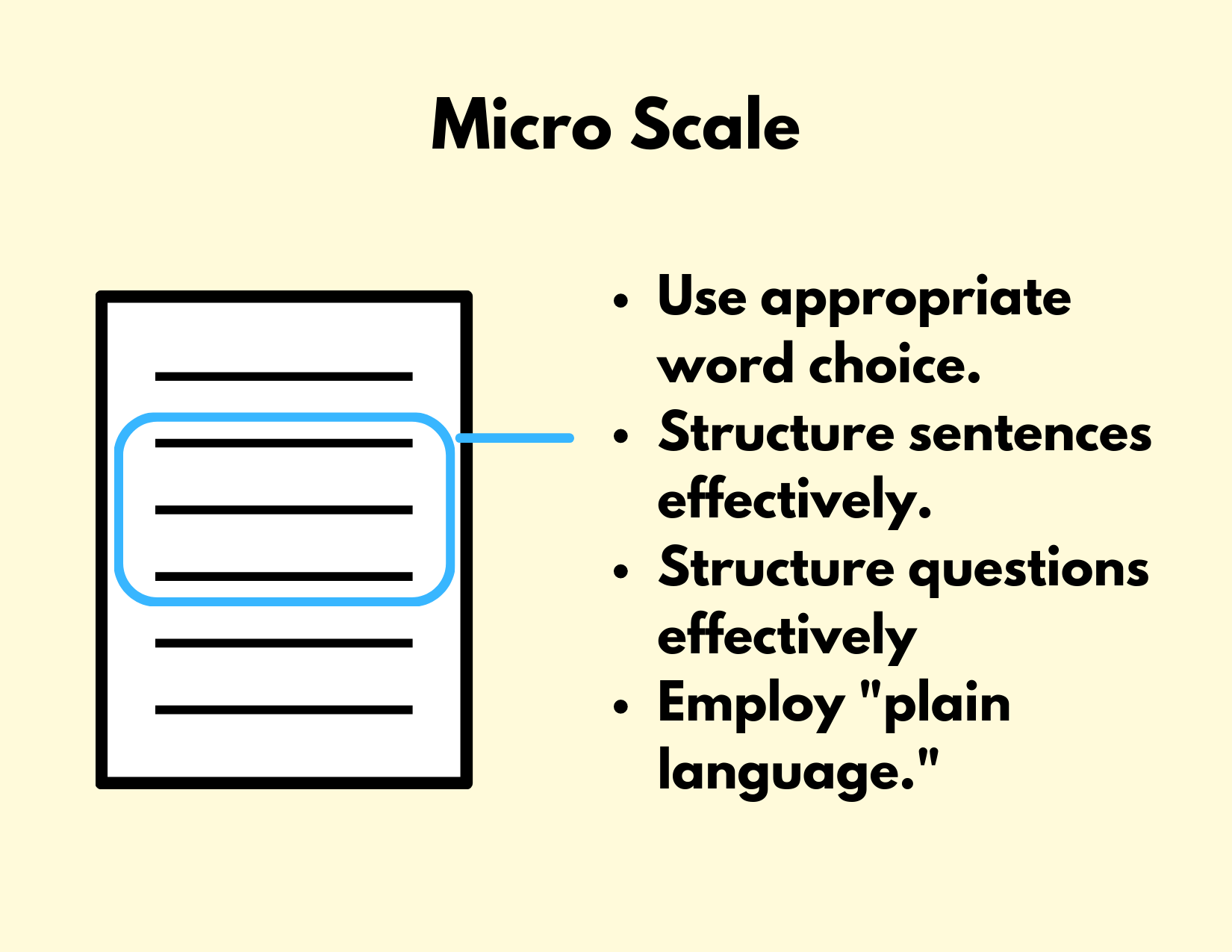
At the Micro Scale, we are addressing the smallest, most detailed scale. Issues at this scale may involve word choice, sentence or paragraph structure. We may need to carefully design a specific question to effectively present legal requirements. The Micro Scale is often what people are referring to when they say “plain language,” though as we will see later, there is a great deal more to this scale than using simple words.
Guiding Questions
These questions may help you recognize when you are working at the Micro Scale:
- This sentence is long and confusing. Can we reword it?
- Can we replace a complicated legal term with something more accessible?
- This question does not make my options clear. How can we restructure it?
- This question simply regurgitates a statute. Can we present these legal requirements in a way that is both accurate and easy to understand?
In the end, the Micro Scale involves analyzing, refining and presenting targeted pieces of information to users. Our goal in the access-to-justice space is to present this information in the simplest way possible, while still meeting all legal requirements.
Action Scale
At the Action Scale, a self-represented person takes a legally-significant step along their legal journey. Often, the Action scale involves filing a document or collection of related documents with a court.
For example, a self-represented person may file a petition for divorce. Depending on a jurisdiction’s requirements, this may involve filing several documents, such as a divorce petition, a preliminary injunction to prevent the opposing party from liquidating assets, and a parenting plan. Although these may be three separate documents, in practice, they function together to form a single “action” or “step” in the divorce process.

Grouping documents effectively requires some critical thinking on the part of a legal designer, and the end result may vary according to jurisdictional requirements. When grouping documents into actions, it is often best to look at this from the self-represented person’s perspective.
Ask yourself: If a self-represented person is going to take a meaningful step towards achieving their goal, does it make sense to complete and file these documents together? How can we communicate the relationships between these documents to a user?
Guiding Questions
These questions may help you recognize when you are working at the Action Scale:
- How can we better organize the questions in a single document? (Bear in mind, some court forms can be 20-30 pages long.)
- How can we structure information across a collection of documents to express relationships between these documents?
- How can we convey to a user that certain documents at this scale may or may not be relevant, depending on their situation?
Process Scale:
At the Process Scale, a user engages in a series of actions that initiate, adjudicate, and create an enforceable legal outcome. Think about stringing several Action Scale steps together to create a beginning-to-end process.
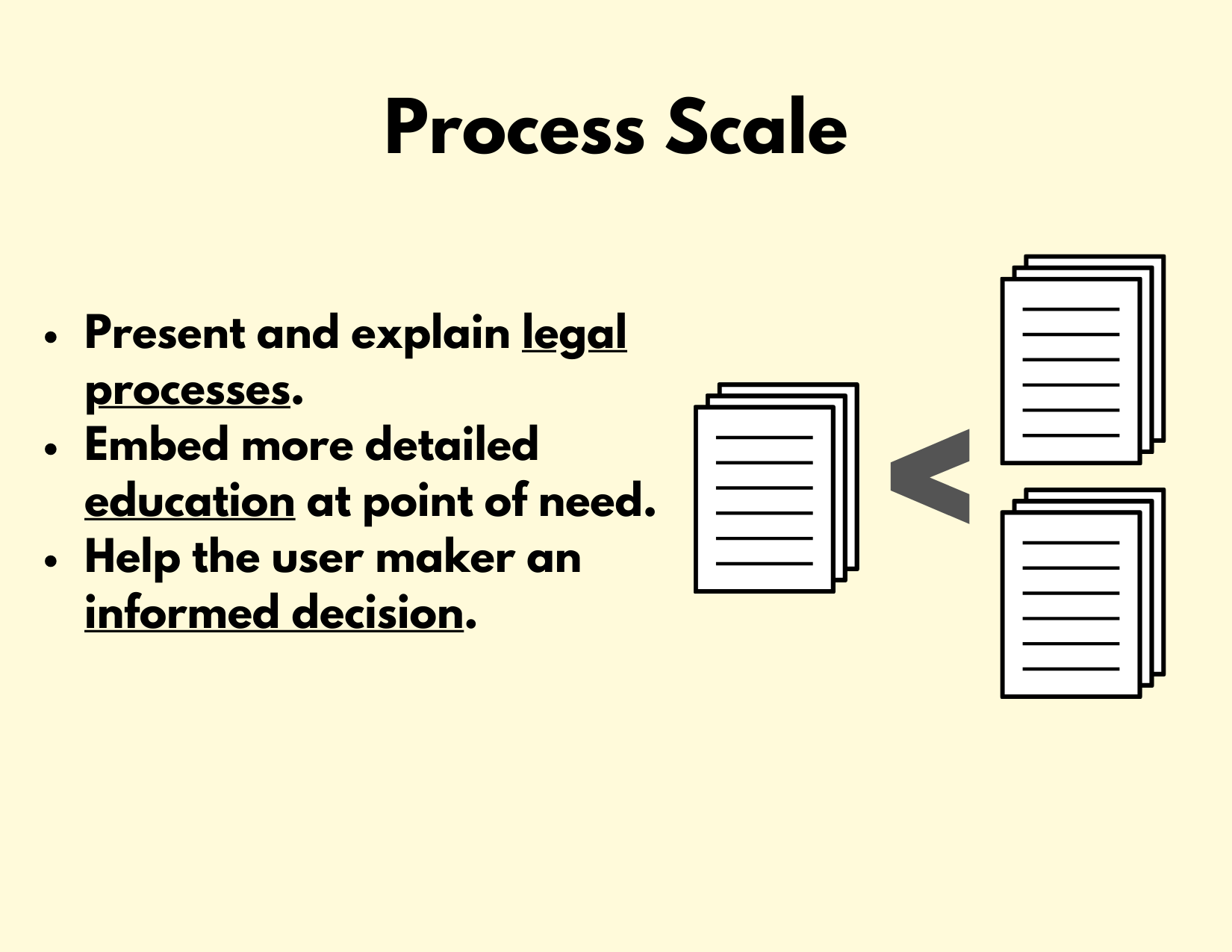
In the divorce context, a self-represented person might file a divorce petition, serve the other party, and attend a resolution management conference. After reaching agreement with the other party, they might file a proposed consent decree, which a judge approves. This is just one possible path that a person might follow from beginning to end, and a well-informed legal professional might already identify other possible outcomes. For example, what happens if the parties do not agree? (This is an example of branching.)
The Process (Macro) Scale is important because this is where a self-represented person makes critical big-picture decisions. The user decides to begin a legal journey that may last months, if not years. The stakes here are high, because a poor, uninformed decision at this scale can result in a tremendous amount of wasted time, to say nothing of the legal consequences if certain rights are waived or altered through a poor decision at this scale.
Guiding Questions:
These questions may help you recognize when you are working at the Process Scale:
- When a user has a legal problem, how do we communicate the options available to address the issue?
- How do we communicate the legal significance of these various options?
- If the process involves “branching,” how do we help a user navigate through these various paths?
Justice Scale
At the Justice Scale, a user with a problem recognizes that their problem involves legal issues. They identify resources to assist with their legal issues, and choose a forum to address the problem.
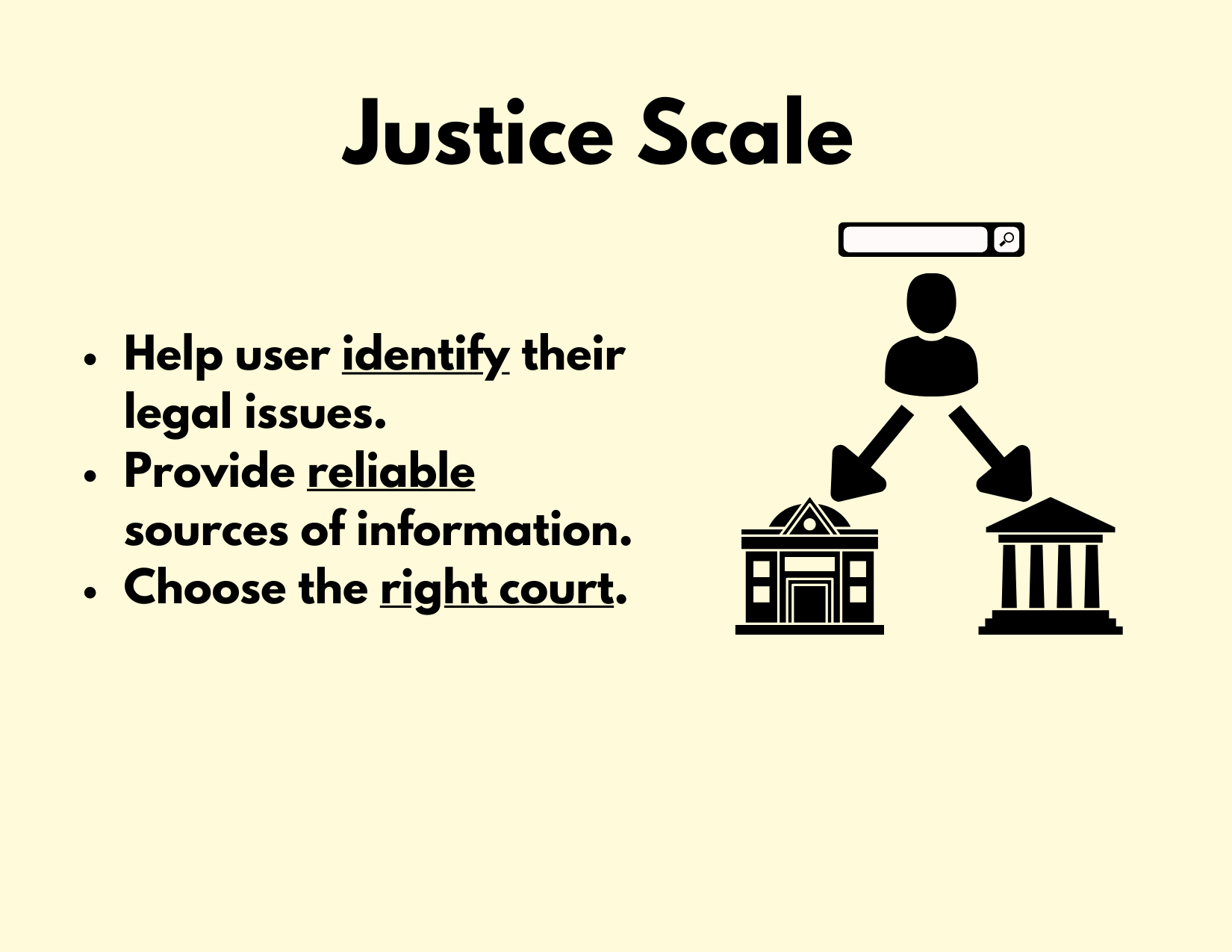
From a self-represented person’s perspective, there are problems first and legal issues second. A person often understands when they have a problem. Perhaps a landlord has served them with an eviction notice or an employer shortchanged them on a paycheck. However, knowing that a problem also involves a legal issue requires that a person understand their legal rights well enough to know they should pursue these questions further.
While internet access makes information plentiful, it does not always help individuals identify the most reliable information sources. And once they do identify a reliable resource, how do they know that the resource is applicable to their jurisdiction? The American justice system is a tapestry of legal systems that connect with, overlap, and abut one another. Similar to the concerns at the Process Scale, there is yet more potential for error and complicated branching that can send a person down the wrong path if these issues are not addressed.
Guiding Questions
These questions may help you recognize when you are working at the Justice Scale:
- How does a user know when they have a legal issue that needs resolved?
- How do we help a person articulate their problem as a legal issue?
- How do we direct users to high-quality legal resources?
- How can a self-represented person choose an appropriate forum to address their legal issues?
Scale Matters Because Self-Represented People Have Different Needs at Each Scale
When we create access-to-justice content for self-represented people, we should always start with the user in mind. Thinking at scale helps us do this, because it helps us think through a user’s decision-making process.
Can you see how? Suppose we reverse the Think at Scale order above:
- Justice Scale – Recognize legal issues and identify the proper legal resources and a forum.
- Process Scale – Identify the right legal process to initiate and pursue to completion.
- Action Scale – Take actions necessary to complete each step in that process.
- Micro Scale – Convey required information accurately and strategically to ensure they effectively convey their side of the story to the court.
From the Justice Scale to the Micro Scale, this framework reflects the process through which a self-represented person must progress to recognize and resolve a legal issue.
As professionals in the access-to-justice space, we must understand that the content we create is contextual. Not only do users have different needs at each scale, but thinking at scale will also help us contextualize our other design principals, allowing us to design content more effectively.
The access-to-justice profession is a rich field where themes and patterns repeat, rhyme and build upon one another. We will refer back to thinking at scale often as we discuss our other design principals and case studies.
 LexTrex